Independent directory. Not the official website of any shopping centre, landlord, Leeds City Council, Leeds BID or any shop. About us
A short history
The Headrow: a street rebuilt between the wars
How a line of narrow old streets on the northern edge of Leeds became one wide avenue of brick and Portland stone — and the landmarks that line it.
The name The Headrow refers to the northern edge — the “head” — of the old town. Until the 20th century it was a set of narrower streets with their own names: Park Lane and Guildford Street to the west, Upperhead Row and Lowerhead Row to the east.
In the 1920s Leeds Corporation decided to widen it into a single east–west avenue, carrying on as a new road, Eastgate. Sir Reginald Blomfield designed the scheme in 1924 and building started in 1929. Every new building had to follow the same style and scale — red brick with Portland stone — which is why the north side still reads as one long, matching frontage. The Depression and then the Second World War slowed the work, and the last of the planned blocks, Headrow House, was not finished until the 1950s.
At the west end the street had already gained three great Victorian buildings: the Town Hall (1858), the Municipal Buildings with the central library (1884) and the Art Gallery (1888). Since then it has gained a sculpture institute, a shopping and leisure centre made from two of the 1930s buildings, and — after 2019–21 works — wider pavements and priority for buses and bikes.
Sources for each item are listed with it below. Where sources disagree we have left the detail out.
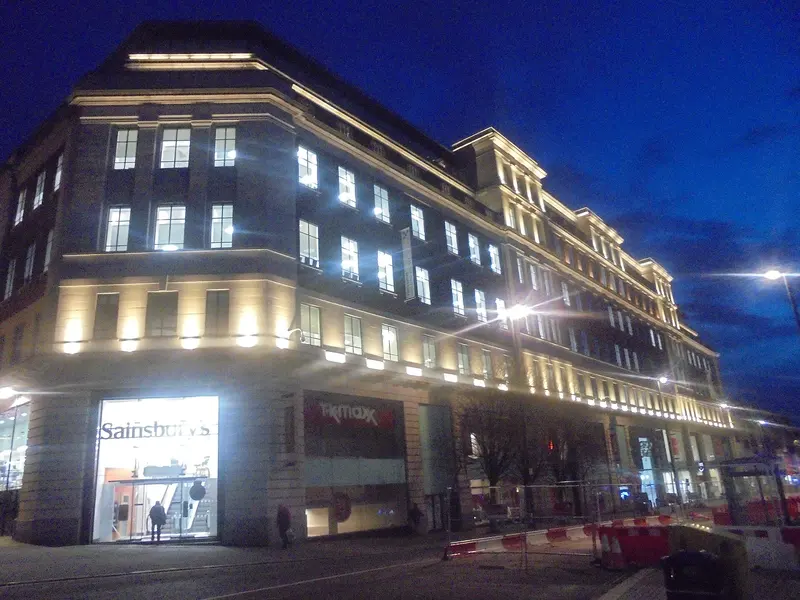
The former Lewis's building on The Headrow, January 2020. Photo: Mtaylor848, CC BY-SA 4.0
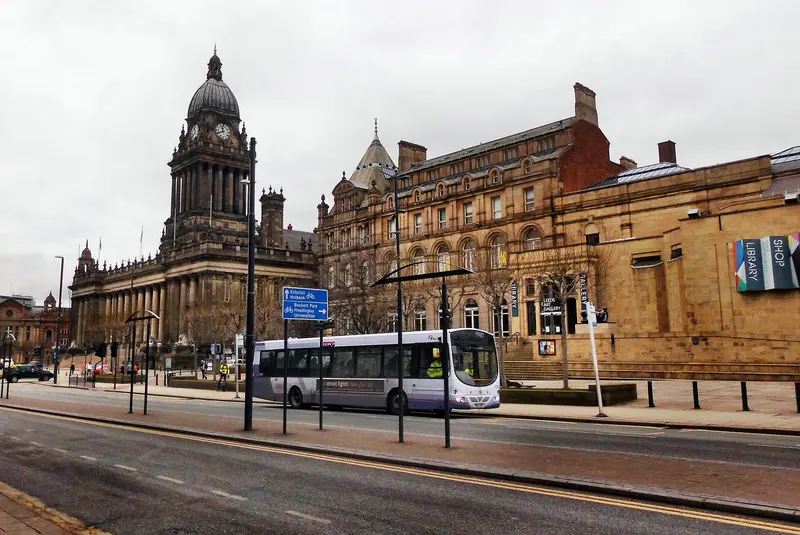
Cuthbert Brodrick’s Grade I listed town hall at the west end of The Headrow, opened by Queen Victoria in 1858.
Built between 1853 and 1858 to designs by Cuthbert Brodrick, the Town Hall was opened by Queen Victoria on 7 September 1858. Its clock tower made it the tallest building in Leeds for more than a century. It is listed Grade I.
In December 2025 Leeds City Council said the building was closed for a major refurbishment — including a new accessible entrance — and that reopening was expected around the end of 2026. Check the Town Hall’s own website for the latest.
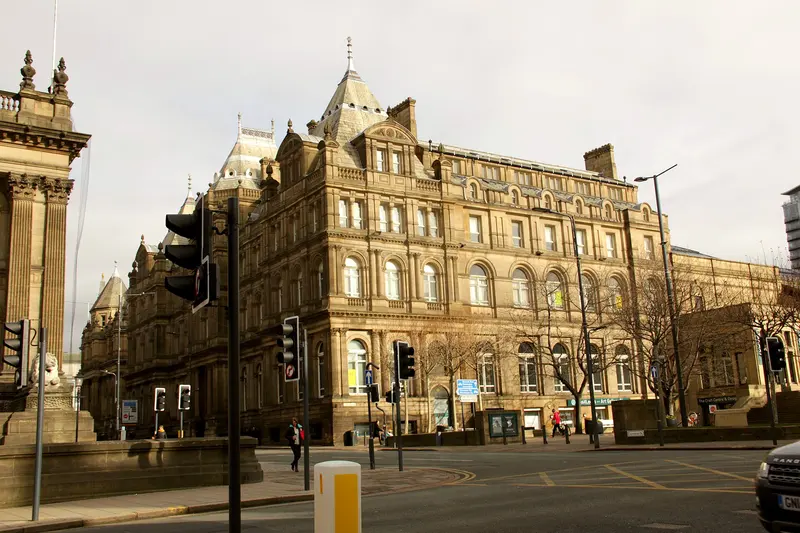
George Corson’s Municipal Buildings of 1878–84, home of the city’s central library — renamed Leeds City Library.
The Municipal Buildings were built between 1878 and 1884 to designs by George Corson and opened on 17 April 1884. They house the city’s central library, which Leeds Libraries has renamed Leeds City Library; its address is on Calverley Street, at the corner of The Headrow. The building is listed Grade II*.
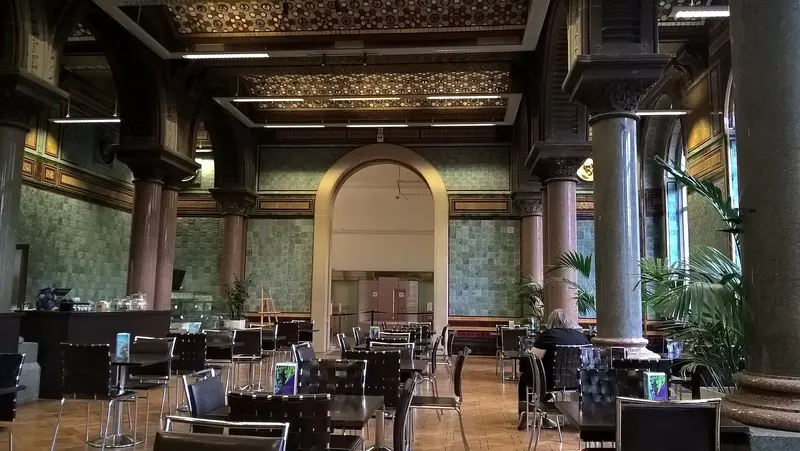
Inside, the former library reading room became the Tiled Hall. Hidden for decades behind later panelling, it was restored and reopened in 2007 as a café linking the library and the Art Gallery.
W. H. Thorp’s gallery of 1888 beside the library, with the Tiled Hall café between them.
Leeds Art Gallery opened to the public on 3 October 1888. It was designed by W. H. Thorp and paid for by public subscription as part of the celebrations of Queen Victoria’s Golden Jubilee. The building is listed Grade II, and its address is The Headrow, LS1 3AA.
In front of the gallery, Victoria Gardens holds the city’s war memorial, which was moved here from City Square in 1937.
A centre for the study of sculpture at 74 The Headrow, opened in April 1993 behind a polished black stone front.
The Henry Moore Institute opened in April 1993 at 74 The Headrow, next door to Leeds Art Gallery. It occupies a Grade II listed range of 1840–47 offices and warehouses on Cookridge Street, restored in 1992 when the black polished stone front was added as the new entrance.
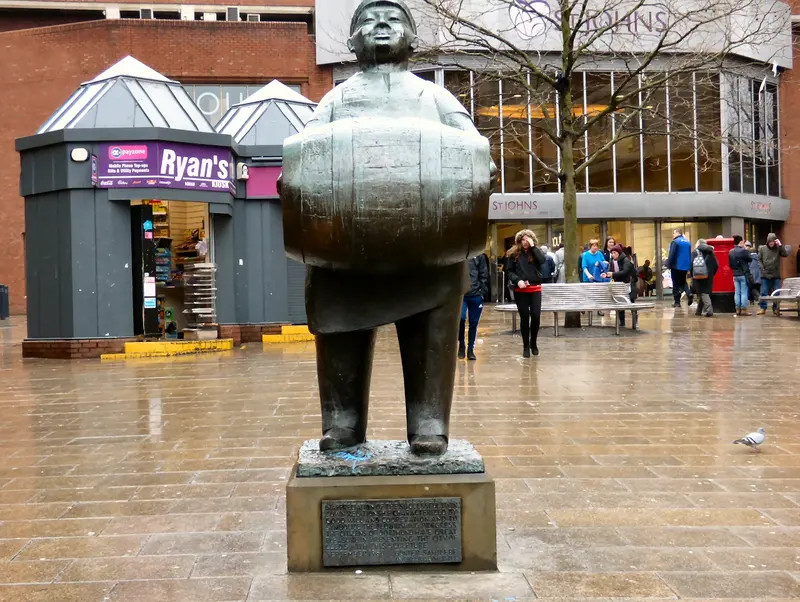
The square named in 1980 for Leeds’ twinning with Dortmund, with the bronze Dortmund Drayman statue.
Leeds has been officially twinned with Dortmund since 1969. The square on the north side of The Headrow was renamed Dortmund Square in 1980 to celebrate the partnership, and the bronze Dortmund Drayman — known locally as “barrel man” — was a gift from the Mayor of Dortmund to the people of Leeds.
Where the Schofields Centre / Headrow Centre — later The Core — stood until its demolition began in 2025.
The shopping centre on the site of the old Schofields department store opened in 1987 as the Schofields Centre, later traded as the Headrow Centre (or Headrow Shopping Centre), and was relaunched as The Core in 2009. Demolition began in early 2025 for the approved Garnet Exchange scheme of student homes above new shops. See our page on what happened to the Headrow Centre.
Before it was rebuilt, the line of The Headrow was a set of narrower streets with older names.
The name refers to the northern edge, or “head”, of the old town. In the 17th century the sections were known by names including Parke Lane, Burley Bar, Upper Head Row and Lower Head Row, and in the 19th century the street was made up of Park Lane, Guildford Street, Upperhead Row and Lowerhead Row.
The city decided to widen the narrow street; Blomfield designed a scheme of uniform brick-and-stone frontages.
Leeds Corporation decided to widen the old street into one wide east–west avenue, and to build Eastgate as its continuation. Sir Reginald Blomfield designed the scheme in 1924. New buildings, mostly by other architects, had to follow the style and scale he set: red brick and Portland stone.
The Leeds Permanent Building Society’s headquarters — the first building of the new Headrow — opened on 15 May 1930.
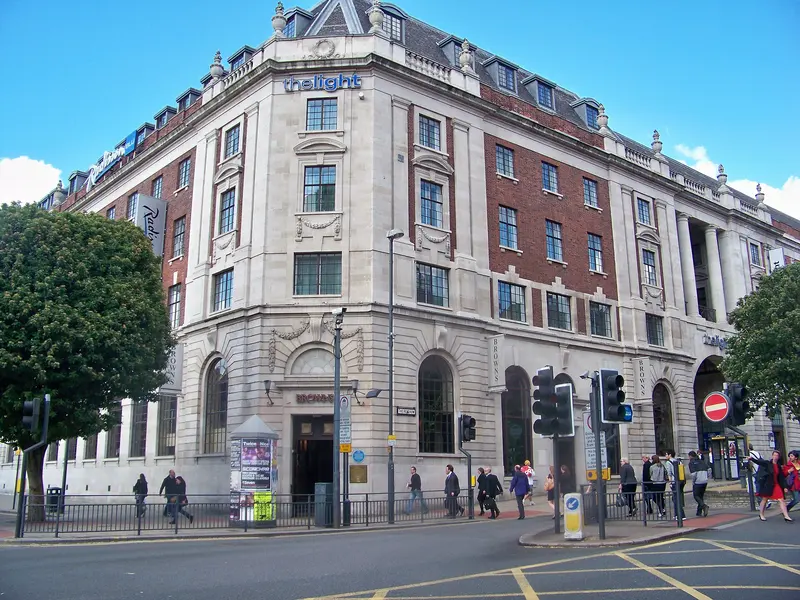
Permanent House and the neighbouring Headrow Buildings (opened on 3 December 1931) were designed by Blomfield with G. W. Atkinson and set the pattern for the rest of the street. Today they form part of The Light.
Lewis’s opened on the newly widened Headrow in September 1932; the building is now called Broad Gate.
Lewis’s traded here until the mid-1990s, when the store became Allders. The building was later split between offices and large shop units, and is now known as Broad Gate.
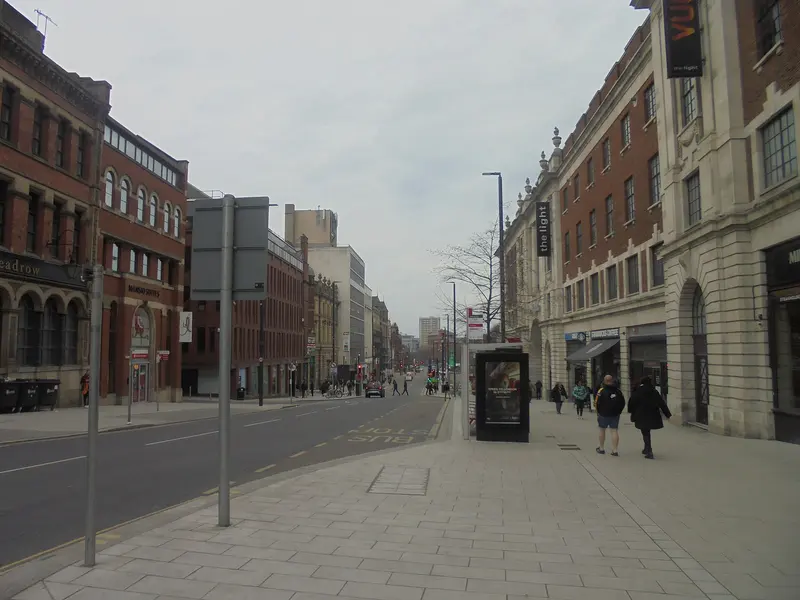
Two years of works gave The Headrow bus and cycle priority, wider pavements, new trees and safer crossings.
Work started in 2019 and Leeds City Council declared it complete on 10 August 2021. The Headrow now has bus gates to remove through traffic, wider pavements, more greenery and safer crossings; Cookridge Street was closed to traffic.